What is decision infrastructure
Enterprises have systems of record, data platforms, and dashboards.
What they lack is the layer that preserves context and granularity
so decisions remain correct when reality changes.

infrastructure
infrastructure
A shared foundation built on context and granularity
Decision infrastructure creates a shared representation of operational reality across functions. It ensures decision outputs remain relevant by preserving:

numbers can be interpreted correctly

decisions are not driven by misleading averages

methods do not drift across regions and teams

the same inputs produce the same outputs

someone can sign off on what is true

Decisions fail when context is lost and granularity is flattened.
What it is not
Decision infrastructure is often confused with adjacent categories.
It is not:

Not Business Intelligence
Dashboards summarize outcomes, they don't structure decisions.
Not Reporting Software
Reporting produces final artifacts, not continuous decision logic.
Not Data Integration
Moving data without preserving meaning is just plumbing.
Not AI Magic
AI infers truth from inputs. It needs infrastructure to be safe.
Visibility without context creates false confidence.
What it produces
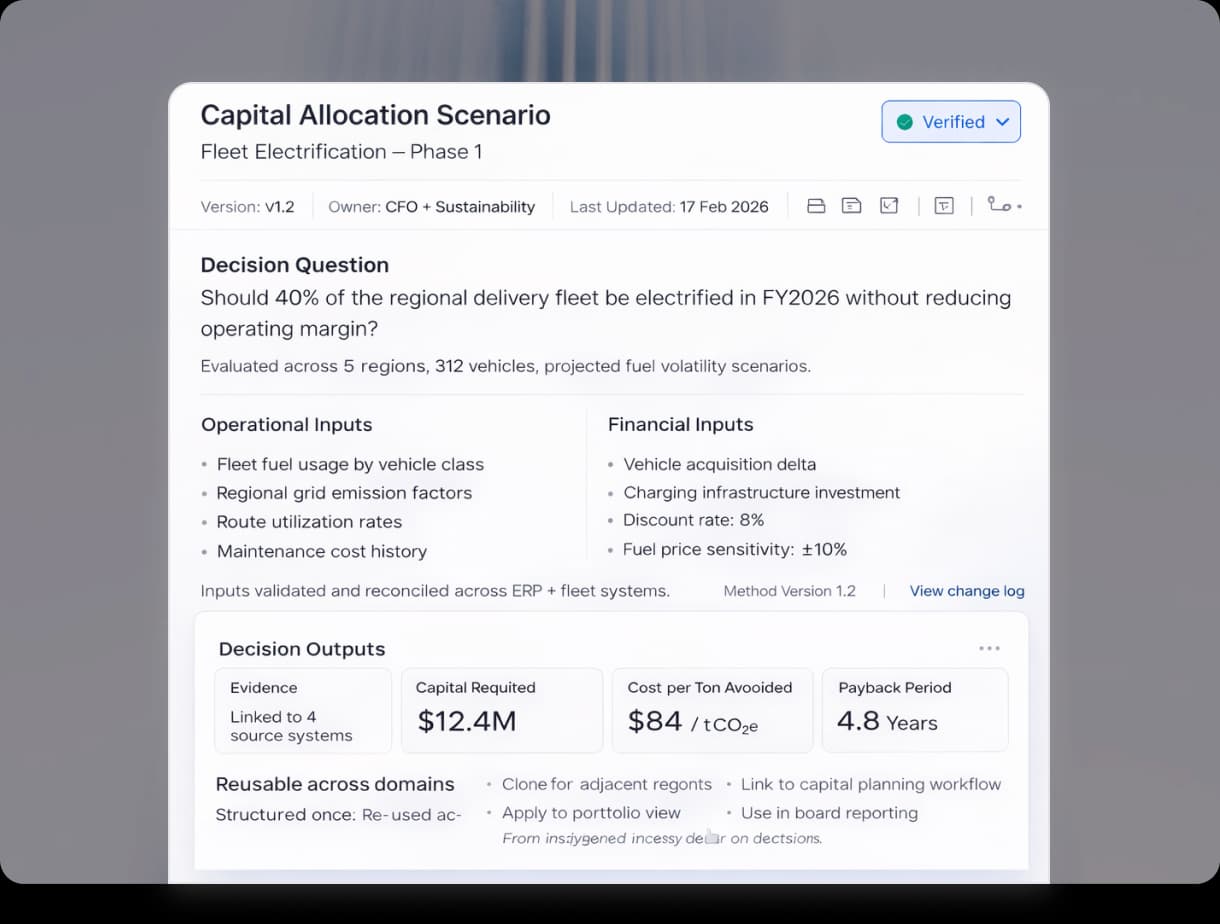
Decision infrastructure produces tangible decision artifacts
that preserve the why behind the number.
Examples include:
 Unified decision baseline with record-level detailExplicit, versioned methodologiesTraceable outputs that retain contextGranular decision evidenceClear accountability
The output is not a report. The output is decision evidence with context.